

When exit signs fail or emergency lights don’t turn on, people panic, evacuations slow down, and legal risks explode. In real emergencies, poor emergency lighting can cost lives. The right solution starts with understanding.
Exit signs and emergency lights are mandatory life-safety systems that guide people safely during power failures, fires, and evacuations. Modern LED exit signs with battery backup ensure compliance with emergency exit signs standards, reduce maintenance, and provide reliable illumination when it matters most.
If you’re responsible for a commercial or industrial building, keep reading. I’ll break everything down clearly and practically.
Table of Contents
Understanding Exit Signs and Emergency Lights
Exit signs and emergency lights are essential parts of any building’s life-safety system. Their main purpose is to guide people to safety during emergencies such as power failures, fires, or other hazardous situations. Exit signs provide clear visual direction, showing occupants where exits are located, while emergency lights ensure that escape paths remain visible when normal lighting is unavailable.
Exit signs are typically illuminated at all times so they can be easily identified, even in smoke-filled or dark conditions. They are placed above doors, along corridors, and at changes in direction to clearly mark the path to an exit. In an emergency, panic and confusion are common, and clearly visible exit signage helps occupants move quickly and calmly toward safety.
Emergency lights, on the other hand, focus on illumination rather than direction. They automatically activate when power is lost, providing light along hallways, stairwells, ramps, and exit doors. This lighting prevents trips, falls, and bottlenecks during evacuation. Without proper emergency illumination, even a clearly marked exit sign may be useless if people cannot see where they are walking.
In real-world applications, exit signs and emergency lights must work together as a complete system. Exit signs tell people where to go, while emergency lights allow them to get there safely. Many compliance issues arise when one component is installed without properly considering the other. For example, a building may have compliant exit signs but insufficient emergency lighting along the escape route, creating a dangerous situation during a blackout.
Building codes and emergency lighting requirements mandate both clear exit signage and adequate emergency illumination. These systems are required in offices, factories, warehouses, hospitals, schools, retail spaces, and other public or commercial buildings. A properly designed system ensures visibility, reduces panic, and supports orderly evacuation, helping protect lives when normal conditions suddenly fail.
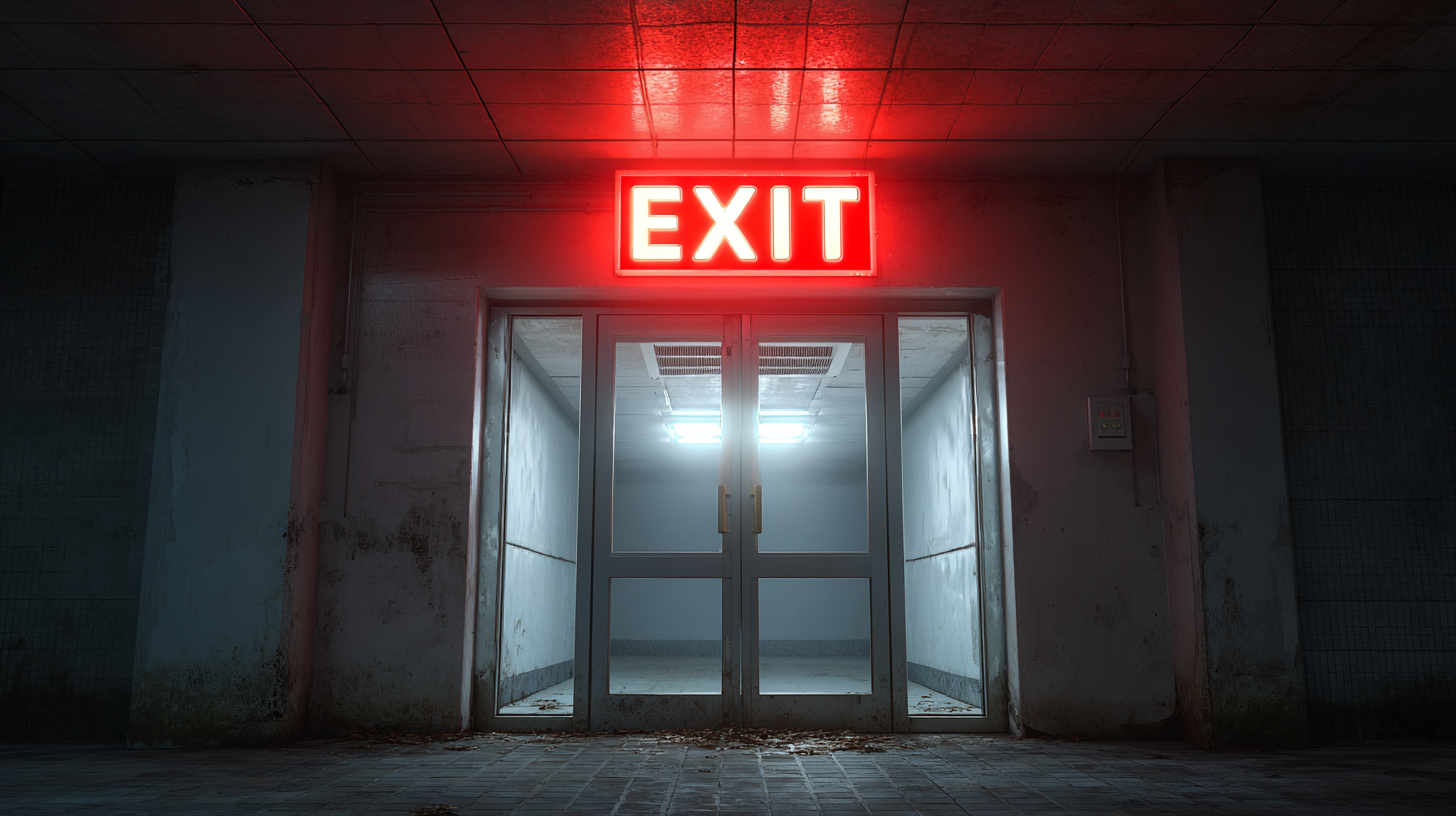
How Do Emergency Lights Work?
Emergency lights are built to turn on automatically the moment normal electrical power is lost. Under standard conditions, these fixtures are connected to the building’s main power supply and remain either off or in standby mode while continuously charging an internal backup battery. This battery is usually a rechargeable lithium-ion or nickel-based battery designed specifically for emergency use.
When a power outage occurs—whether caused by a blackout, fire, or electrical failure—the emergency light detects the loss of voltage instantly. The internal control circuit switches power from the main supply to the battery without delay. This automatic transfer ensures there is no gap in illumination, which is critical during evacuations when even a few seconds of darkness can cause panic or injury.
Most LED emergency lights are designed to operate for a minimum duration of 90 minutes or 180 minutes, which is the commonly required runtime under building and fire safety codes. This duration provides enough time for occupants to evacuate safely and for emergency responders to take control of the situation. Because LEDs use very low wattage compared to older incandescent or halogen lamps, they are able to maintain usable brightness for the full required time without draining the battery too quickly.
Some larger facilities also use generator-backed emergency lighting systems. In these setups, a generator supplies power after a short delay. However, local battery backup within each emergency light is still critical. Batteries provide immediate illumination before the generator starts and act as a fail-safe if the generator does not engage or experiences a fault.
Modern emergency lighting systems often include self-testing and diagnostic features. These systems periodically test battery condition, charging circuits, and LED performance to ensure the fixture will function correctly during an actual emergency. Visual indicators on the fixture may show charging status or alert maintenance staff if a battery needs replacement.
In simple terms, emergency lights work by storing energy in advance and releasing it instantly when normal power disappears. This reliable, automatic operation is what makes LED emergency lights a vital safety component in commercial, industrial, and public buildings.

Types of Emergency Exit Signs and Lights
Emergency exit signs and emergency lighting fixtures come in several designs, each suited to specific building layouts, safety needs, and environmental conditions. Selecting the right type ensures compliance with emergency exit sign standards and provides reliable guidance during power outages or emergencies.
Standard LED Exit Signs
Standard LED exit signs are the most widely used option in commercial and public buildings. They clearly display the word “EXIT” using high-visibility lettering and are typically mounted on walls or ceilings above exit doors. These signs include internal battery backup systems that keep the sign illuminated for the required emergency duration. LED technology ensures long lifespan, low power consumption, and consistent brightness.
Combination Exit Signs with Emergency Lights
Combination exit signs integrate one or two adjustable emergency light heads into the same unit as the exit sign. When power fails, the exit sign remains illuminated while the emergency light heads turn on to light the egress path. These units are commonly used in corridors, stairwells, and small rooms where both signage and pathway lighting are needed from a single fixture.
Remote-Capable Exit Signs
Remote-capable exit signs are designed to power additional emergency lighting fixtures located away from the main unit. These remote heads are connected by wiring and activate simultaneously during a power failure. This setup is ideal for larger spaces, long corridors, or areas with multiple obstacles where a single light source is not sufficient.
Emergency Light-Only Fixtures
Emergency light-only fixtures do not include exit signage. Instead, they focus solely on illuminating escape routes, stairways, ramps, and open areas. These fixtures often feature adjustable lamp heads to direct light precisely where it is needed. They are typically installed alongside exit signs to provide complete emergency coverage.
Outdoor LED Exit Signs and Emergency Lights
Outdoor exit signs and emergency lights are built for exterior environments. They feature weather-resistant housings, sealed gaskets, and corrosion-resistant materials to withstand rain, dust, heat, and cold. These fixtures are commonly used at exterior exits, loading docks, parking structures, and industrial sites where exits lead directly outdoors.
Explosion-Proof Emergency Lights and Exit Signs
In hazardous environments such as oil and gas facilities, chemical plants, or manufacturing areas with flammable vapors, explosion-proof emergency lighting is required. These fixtures are designed to prevent sparks or heat from igniting surrounding gases. They feature heavy-duty enclosures and specialized certifications for hazardous locations.
Vandal-Resistant Emergency Fixtures
Vandal-resistant exit signs and emergency lights are designed for public spaces, schools, transit stations, and correctional facilities. They use reinforced housings, impact-resistant lenses, and tamper-proof fasteners to protect against damage or misuse while maintaining reliable emergency performance.
Each type of emergency exit sign and lighting fixture serves a specific purpose. The correct selection depends on building size, occupancy type, environmental exposure, and applicable safety codes. Using the right combination ensures clear guidance, proper illumination, and full compliance during emergencies.
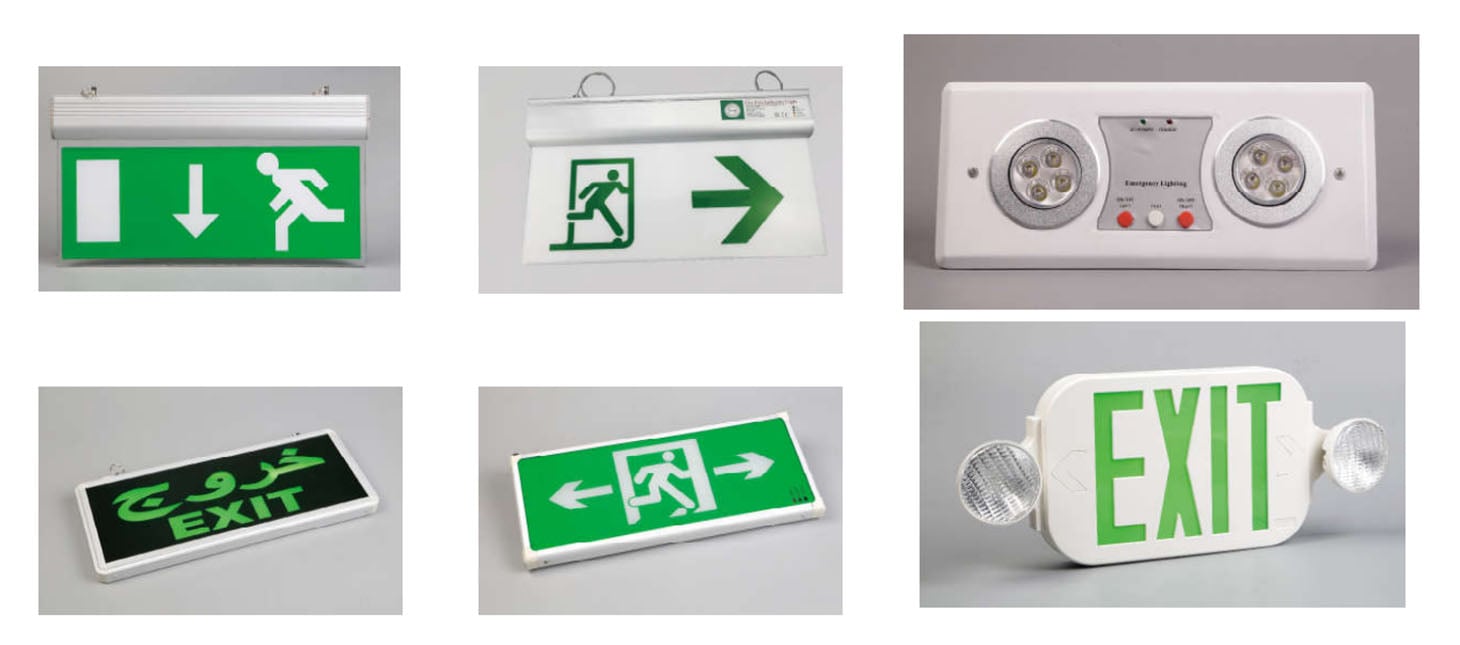
What Is the Difference Between Exit Lights, Emergency Lights, and Escape Lighting?
Exit lights, emergency lights, and escape lighting are closely related, but they each serve a distinct role in building safety and evacuation planning. Understanding the difference is important for proper system design and code compliance.
Exit lights are visual indicators. Their main purpose is to clearly mark the location of exits so occupants know where to leave the building. They typically display the word “EXIT,” often with directional arrows to guide people toward the nearest safe exit. Exit lights must remain visible at all times, including during normal operation and power outages. They do not usually provide significant illumination for the floor or walking surface; their job is guidance, not lighting.
Emergency lights are illumination devices. They turn on automatically when normal power fails and provide light along egress paths such as corridors, stairways, ramps, and open areas. Emergency lights help people see obstacles, changes in elevation, doors, and stairs during an evacuation. Without emergency lighting, exit signs alone would not be enough, as occupants may know where to go but be unable to see the path safely.
Escape lighting refers to the complete evacuation lighting system as a whole. It includes exit lights, emergency lights, and any additional luminaires that ensure the entire escape route is usable from start to finish. Escape lighting covers everything from the moment normal power fails until occupants safely reach an exit and move to a place of safety outside the building. This system is designed to work together, ensuring both visibility and clear direction throughout the evacuation process.
In simple terms, exit lights provide direction, emergency lights provide visibility, and escape lighting ensures the entire evacuation route is safe, continuous, and functional during an emergency.
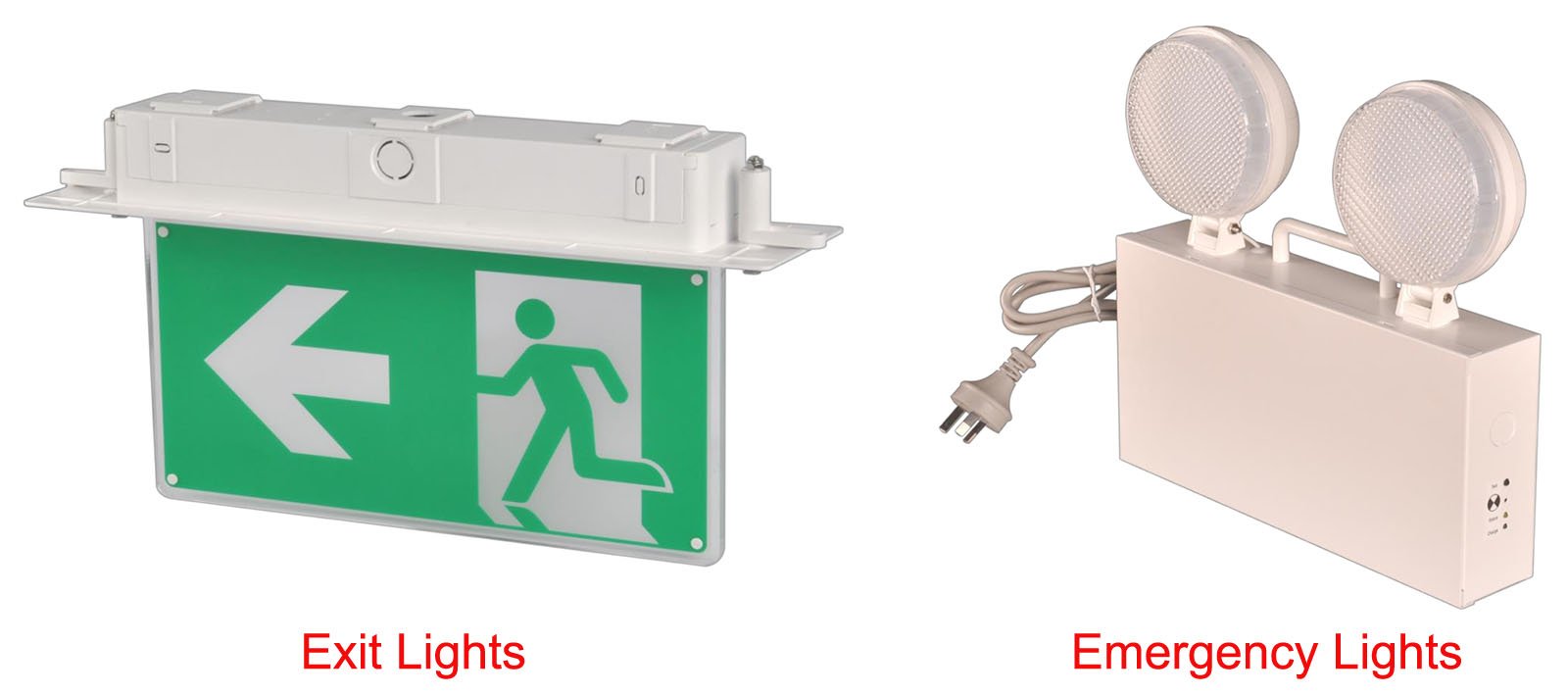
Exit Lights vs Emergency Lights
Emergency Lighting Regulations: What Are the Rules for Emergency Exit Lights?
Emergency lighting regulations are designed to ensure that occupants can safely evacuate a building during power failures, fires, or other emergencies. While the exact requirements differ by country and jurisdiction, most regulations are based on well-established standards such as NFPA (National Fire Protection Association), IEC (International Electrotechnical Commission), EN (European Norms), or local building and fire codes.
One of the core requirements across all standards is automatic operation. Emergency exit lights must activate immediately when normal power is interrupted. This activation cannot rely on manual switches or human intervention. The system must respond instantly to avoid darkness during critical moments.
Another key rule is minimum illumination level. Regulations specify how much light must be provided along escape routes, including corridors, stairways, ramps, and exit doors. The goal is to ensure occupants can clearly see the path, identify obstacles, and safely navigate changes in floor level. Even low-level lighting is acceptable, as long as it meets the minimum lux requirements defined by the code.
Duration is also strictly regulated. Emergency exit lights must remain illuminated for a minimum period, most commonly 90 minutes. This duration is considered sufficient to allow full evacuation and support emergency response activities. Battery-backed systems must be capable of sustaining light output for the entire required duration without significant loss of brightness.
Placement and spacing rules ensure consistent coverage. Emergency exit lights must be installed at exits, along escape routes, near staircases, changes in direction, and at areas where hazards may exist. Maximum spacing distances are often defined to prevent dark gaps between fixtures. Exit signs must also remain visible from a specified distance and angle, even in smoke-filled conditions.
Visibility and clarity are essential. Exit signs must use approved colors, symbols, and lettering sizes so occupants can quickly recognize them during stress. In many regions, signs must remain illuminated at all times, not only during emergencies, to ensure familiarity and immediate recognition.
Testing and maintenance are mandatory under most regulations. Building owners are required to perform regular functional tests, battery checks, and full-duration tests to verify system reliability. Records of these tests are often required during safety inspections.
Non-compliance with emergency lighting regulations can lead to serious consequences. Failed inspections may result in fines, operational restrictions, or even building closure. More importantly, inadequate emergency lighting puts lives at risk during emergencies.
Following emergency lighting code requirements is not just about passing inspections—it is about ensuring that every occupant has a clear, visible, and safe path to exit when it matters most.
What Are the OSHA Standards for Emergency Exits and Exit Signs?
OSHA lighting standards require exit routes to be adequately illuminated and clearly marked at all times. Exit signs must be visible, legible, and continuously illuminated. OSHA workplace lighting requirements in lux define minimum light levels for exit access and emergency pathways. OSHA lighting standards for general industry, office environments, and construction sites all emphasize reliable backup power. Using LED emergency exit lights with battery backup is one of the easiest ways to meet OSHA requirements while reducing maintenance headaches.
Where to Install Emergency Exit Lights?
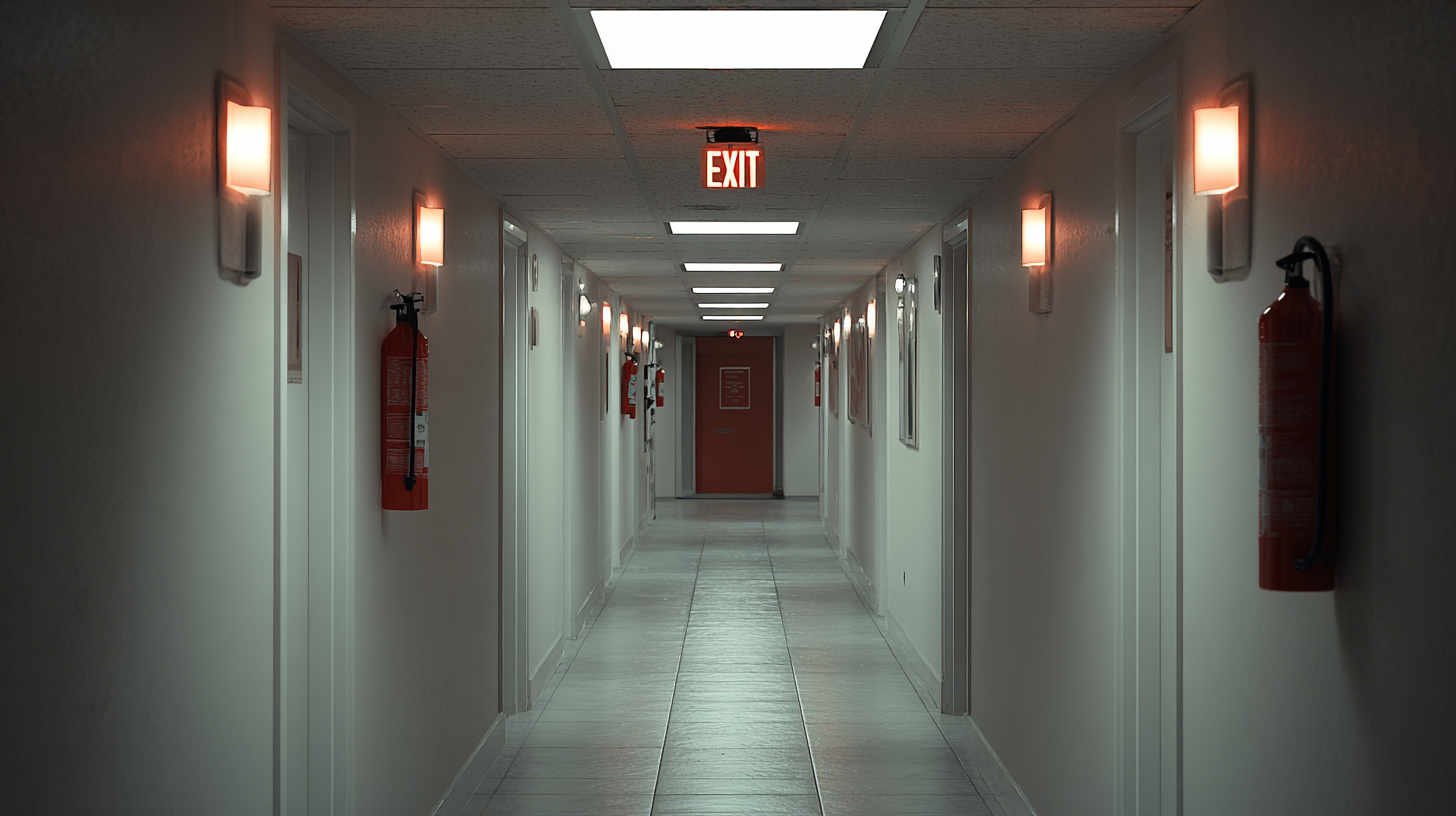
Emergency exit lights must be installed along all designated egress routes to ensure occupants can evacuate safely during a power failure. These routes include corridors, aisles, stairways, ramps, and all paths that lead directly to an exit door. The primary goal is to provide continuous, clear illumination from any occupied area to a place of safety.
Exit doors themselves must be clearly illuminated so they are immediately recognizable, even to people unfamiliar with the building. Emergency lights should be positioned above or near exit doors, as well as on both sides of stairwells to illuminate steps, landings, and handrails. Any change in elevation, such as stairs, ramps, or floor level transitions, must receive special attention to prevent trips and falls during evacuation.
Emergency exit lights are also required at points where the direction of travel changes. Long corridors with turns or intersections should never be left in darkness, as confusion during emergencies can cause panic or delays. Fire doors, cross-corridor doors, and access points to exit routes should all be clearly visible under emergency lighting.
Outdoor emergency exit lights are necessary where exits discharge directly to the outside. These fixtures ensure that people can safely move away from the building after exiting, especially in areas with uneven ground, steps, or ramps. Parking areas, exterior walkways, and assembly points connected to exit routes may also require emergency illumination depending on local regulations.
In practice, emergency lights should be spaced so that there are no dark zones when normal lighting fails. Light levels must be sufficient to clearly identify obstacles, signage, and pathways. A well-planned emergency lighting layout considers building size, layout complexity, and occupant load, ensuring smooth evacuation even during smoke, panic, or unfamiliar surroundings.

Factors to Consider for Installing Exit Signs
When installing exit signs, visibility should always come first. Exit signs must be clearly readable from the required viewing distance along the exit route. They should be positioned so that occupants can immediately identify the direction of travel without confusion. Signs must never be blocked by walls, columns, decorative features, doors, or equipment. In larger buildings or complex layouts, additional directional exit signs may be necessary to guide occupants step by step toward the final exit.
Battery capacity is another critical factor. Most exit signs rely on internal rechargeable batteries to remain illuminated during a power outage. The battery must be capable of supporting the sign for the required emergency duration, typically 90 minutes or more. High-quality batteries ensure consistent brightness throughout the emergency period rather than dimming prematurely. Regular testing and easy battery replacement access should also be considered during product selection.
LED exit sign wattage plays an important role in efficiency and reliability. LED exit signs consume very little power while delivering bright, even illumination. Lower wattage reduces energy costs and allows batteries to last longer during emergencies. LED technology also produces less heat, which improves component longevity and reduces the risk of internal failures.
Compliance certifications are non-negotiable. Exit signs must meet applicable safety and building codes, such as local fire regulations and workplace safety standards. Certified products ensure the sign meets requirements for brightness, letter size, visibility distance, and emergency operation. Installing non-compliant exit signs can result in failed inspections, fines, or forced replacement.
The mounting method should match the building layout and ceiling structure. Exit signs can be ceiling-mounted, wall-mounted, recessed, or suspended. The chosen method must ensure clear sightlines from all relevant angles. Adjustable mounting options offer flexibility for unusual layouts or renovations where existing mounting points may not be ideal.
Environmental conditions also influence exit sign selection. In areas with high humidity, dust, temperature extremes, or outdoor exposure, exit signs must have suitable protective housings. Damp locations may require sealed or moisture-resistant designs, while industrial environments benefit from impact-resistant or vandal-resistant models.
From a cost perspective, long-term value matters more than upfront price. Energy-efficient LED exit signs with long lifespans reduce electricity consumption and maintenance costs over time. Fewer lamp replacements and longer battery life translate into lower total ownership costs, especially in large facilities with many exit signs.
By carefully considering visibility, power backup, efficiency, compliance, environment, and installation method, exit signs can be installed correctly the first time—ensuring safety, code compliance, and long-term reliability.
Best Practices for Installing Exit Signs
Always follow local building codes, fire regulations, and manufacturer installation instructions. These rules exist to ensure exit signs perform correctly during emergencies and pass safety inspections. Skipping code requirements or improvising installation methods often leads to compliance failures and costly corrections later.
Mount exit signs at consistent heights throughout the building so occupants instinctively know where to look. Inconsistent placement can cause confusion during emergencies, especially in low-visibility situations. Signs should be installed high enough to remain visible over crowds but low enough to stay within required viewing angles.
Directional arrows must clearly indicate the correct exit path. Arrows should never point toward dead ends, storage rooms, or locked doors. In complex layouts, use multiple directional signs to guide occupants step by step toward the final exit rather than relying on a single sign.
Use double-sided exit signs in corridors, open areas, or large rooms where people may approach from different directions. This ensures visibility from multiple angles and prevents occupants from missing critical exit information during an evacuation.
For large or multi-level buildings, perform a detailed lighting and signage layout before installation. This planning phase helps identify optimal sign locations, spacing, and sightlines. It also ensures exit signs integrate properly with emergency lighting systems, stairwells, and evacuation routes.
After installation, test every exit sign and emergency light. Confirm that the signs remain illuminated during normal operation and switch to battery power instantly during a power outage. Verify battery duration, brightness, and arrow visibility. Regular testing not only confirms functionality but also prepares the building for inspections and real emergencies.
From experience, facilities that invest time in proper planning, consistent installation, and thorough testing pass inspections more smoothly and avoid unnecessary rework. A well-installed exit sign system improves safety, compliance, and peace of mind for building owners and occupants alike.
Benefits of LED Exit Signs
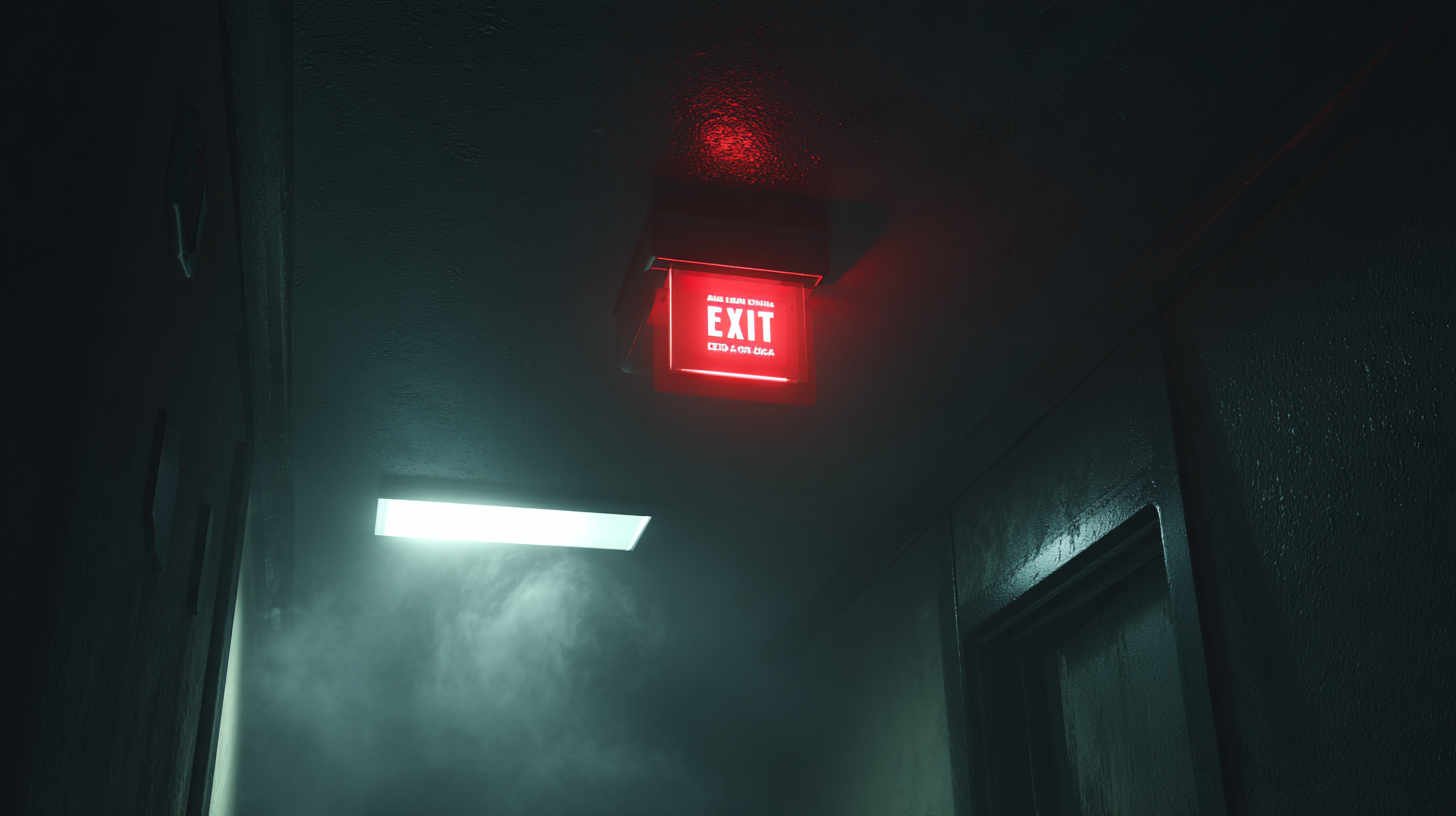
LED exit signs deliver clear advantages compared to traditional incandescent or fluorescent exit signs, making them the preferred choice for modern commercial and industrial buildings. One of the most noticeable benefits is energy efficiency. Most LED exit signs operate at very low power levels, often below 5 watts, which significantly reduces electricity consumption and lowers long-term operating costs. In facilities where exit signs run 24/7, these energy savings add up quickly.
Another major advantage is longevity. LED exit signs typically last over 50,000 hours, which means years of continuous operation without lamp replacement. This dramatically reduces maintenance labor, replacement parts, and downtime. For large buildings with many exit signs, the reduction in maintenance alone represents a substantial cost benefit.
LED emergency exit lights with battery backup also provide reliable performance during power outages. LEDs turn on instantly with no warm-up time, ensuring escape routes are illuminated immediately when normal power fails. Battery backup systems paired with LED technology offer consistent brightness throughout the required emergency duration, improving safety during evacuations.
From a compliance standpoint, LED exit signs help facilities meet emergency lighting and exit signage regulations more easily. Their stable light output, long battery life, and clear visibility support building code requirements and simplify inspections.
For B2B buyers, LED exit signs deliver a strong return on investment. Lower energy bills, reduced maintenance costs, long service life, and improved safety make them a cost-effective, dependable solution for offices, factories, warehouses, schools, hospitals, and public buildings. Over time, LED exit signs not only pay for themselves but also enhance overall building safety and operational efficiency.
Maintaining and Testing Exit Signs
Regular maintenance and testing of exit signs are essential to ensure they function correctly during emergencies and remain compliant with safety regulations. Exit signs are life-safety devices, and any failure during a power outage can put occupants at serious risk. Most building codes require a structured inspection and testing routine, and following it consistently helps avoid penalties, failed inspections, and unsafe conditions.
Monthly visual inspections are the first line of defense. During these checks, facility staff should confirm that every exit sign is clearly illuminated, visible from the required distance, and free from physical damage. This includes checking that lenses are clean, lettering is legible, directional arrows are correct, and no fixtures are blocked by decorations, storage, or building modifications. Battery indicator lights should also be checked to ensure the battery is charging properly.
Annual full-duration testing is equally important. This test simulates a real power failure by cutting normal power to the exit sign and verifying that the battery can keep the sign illuminated for the full required duration, typically 90 minutes. During this test, brightness should remain consistent and clearly visible throughout the entire period. Any sign that dims, flickers, or shuts off early must be repaired or replaced immediately.
LED exit signs simplify maintenance compared to older technologies. Their lower power consumption reduces battery strain, and their long lifespan minimizes lamp failures. However, batteries still age over time and must be replaced according to manufacturer recommendations, usually every three to five years. Using high-quality replacement batteries ensures reliable emergency performance.
Recordkeeping is a critical part of exit sign maintenance. Inspection dates, test results, battery replacements, and corrective actions should all be documented. These records provide proof of compliance during safety audits, fire inspections, or insurance reviews. Buildings with complete maintenance logs are far less likely to face fines or forced upgrades.
In larger facilities, centralized testing systems or self-diagnostic exit signs can further streamline maintenance. These systems automatically perform routine checks and alert staff when a problem is detected, reducing manual labor and the risk of human error.
Consistent maintenance and testing not only ensure regulatory compliance but also protect lives. Well-maintained exit signs give occupants clear guidance during emergencies, reduce panic, and support safe, orderly evacuations when every second counts.
FAQs About LED Exit Signs and Emergency Lights
How often should the auxiliary power supply and emergency lighting system be tested?
Most safety codes require emergency lighting systems to be visually inspected every month to confirm they are functioning and illuminated. In addition, a full-duration test is typically required once a year. This test verifies that batteries or backup systems can power the lights for the full emergency period, usually at least 90 minutes.
Do exit signs need battery backup if on generator?
In many regions, yes. Battery backup is required even when a generator is present because it provides immediate illumination during the short delay before a generator starts. Battery backup also serves as redundancy if the generator fails or is under maintenance.
How are most exit signs wired in?
Most commercial exit signs are hardwired directly to the building’s electrical supply. They include an internal rechargeable battery that remains charged during normal operation and automatically powers the sign when mains power is lost.
Do exit signs need electricity?
Yes. Exit signs require electricity to stay illuminated continuously and to keep their internal batteries charged. Even photoluminescent signs often require external lighting to remain visible in low-light conditions.
Do emergency exit signs have to be hardwired?
In most commercial and public buildings, hardwired exit signs are required by code. Battery-only exit signs are generally limited to temporary installations, portable structures, or locations where wiring is impractical and permitted by local regulations.
How are emergency exit signs powered?
Emergency exit signs are typically powered by mains electricity with an internal battery backup. In some facilities, they may also be connected to emergency generators, but battery backup is still commonly required for immediate response.
Are there battery operated exit signs?
Yes, battery-operated exit signs exist, but they are usually intended for temporary use, portable buildings, or special situations. They are less common in permanent commercial installations due to limited runtime and stricter code requirements.
Should emergency exit lights be on all the time?
Exit signs must remain illuminated continuously so occupants can always identify exit routes. Emergency light heads may remain off during normal operation but must turn on automatically during a power failure.
Is an exit light an emergency light?
No. An exit light provides visual direction by displaying exit signage, while an emergency light provides illumination along pathways, corridors, and stairs. Both work together as part of a complete emergency lighting system.
Can emergency lighting be used as escape lighting?
Yes. Emergency lighting is a critical component of escape lighting. Escape lighting refers to the full system that enables safe evacuation, including exit signs, emergency luminaires, and illuminated pathways.
Why are some exit signs green or red?
Color requirements vary by region and local regulations. Green exit signs are common in Europe and many international standards, while red exit signs are widely used in North America. The key requirement is visibility, legibility, and compliance with local codes.
How often are emergency lighting testing and inspections required?
Emergency lighting systems are typically subject to monthly visual inspections and annual full-duration testing. These checks ensure proper operation, battery health, and compliance with fire and building safety regulations.

Conclusion
Exit signs and emergency lights are not optional extras; they are essential life-safety systems. Choosing high-quality LED exit signs with battery backup ensures compliance, reliability, and long-term cost savings. With proper installation and maintenance, emergency lighting protects people and property when it matters most.
If you’re planning a new project or upgrading your emergency lighting system, contact us anytime. We’re ready to help you choose the best LED exit signs and emergency lights for your needs.
Featured Products

Request A Free Quote Now!
Send us a message if you have any questions or request a quote. We will get back to you ASAP!



Leave a Reply
Your email is safe with us.